Disengagement is multi-causal and largely invisible — isolation, misplacement, and under-development all hide in collaboration patterns leadership can’t see. CultureConnect builds the workplace relationship graph, with a Coordinator and an AI layer working alongside it, so leadership goes from no visibility into the human network at work to specific, prioritized action.
The Coordinator is a CultureConnect specialist who interprets the data and works alongside client leadership to translate insight into action.
Intentional rooms for new parents, mentorship, meditation, wellness, and the groups your team actually needs. Every room is shaped to your culture, not pulled from a template.
Coworkers find each other, especially the ones who never share a hallway.
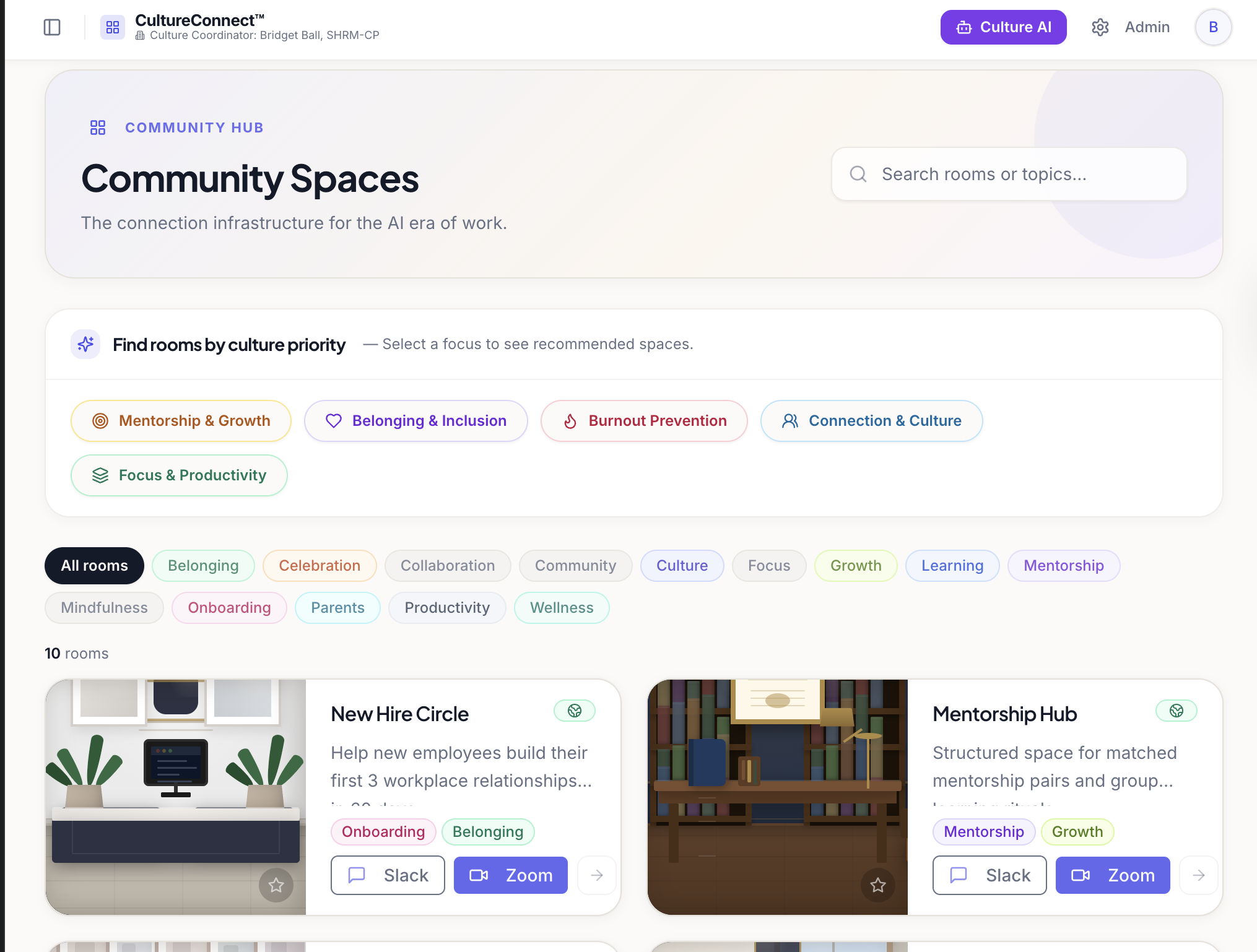
Live screenshot from the current build. Spaces shaped to your team. The rooms run themselves. The Coordinator reads the patterns across them.
Three things, in order. Each one earns the next.
Rooms
Community Rooms for new parents, mentorship, meditation, wellness, and the groups your team actually needs. Every room is shaped to your culture, not pulled from a template. Coworkers find each other, especially the ones who never share a hallway.
Insights
Who is showing up. Who is drifting. Which rooms are landing. Which pairs need a check-in. The Coordinator captures it all in structured fields, never free text, so the signal can be aggregated and acted on.
Brief
Patterns, never people. The Coordinator translates what surfaced across the rooms into a short monthly brief: what changed, what it means, and what to do next. Aggregate by design. The brief is what leadership uses to improve organizational relationships.
CultureConnect doesn’t just measure connection. It gives leadership actionable insight they currently lack — pulled from the workplace relationship graph and translated by the Coordinator into a short list of decisions worth making this month.
The people whose collaboration network is thinning before they tell anyone. Drift signals show up in the graph weeks before they show up in a resignation letter. Leadership gets the names early enough to act.
Who’s gravitating toward which functions, mentors, or skill areas — signals that surface internal-mobility appetite long before HR runs another engagement survey. Leadership sees where development investment will land.
When work consistently flows past a function or seat, the graph shows it. Capability gaps become specific — this skill, on this team, at this scale — instead of vague org-chart complaints.
The people whose departure would silently break ten working relationships. They rarely appear on a 9-box. The graph identifies them, the Coordinator names them, leadership invests in them before they leave.
The shift
Leadership goes from no visibility into the human network to a short, prioritized list of moves to make this month. The Coordinator carries the interpretation. The brief carries the recommendation. The decision stays with you.
Engagement happens in real life. The app observes whether it is happening and prompts when it is not. The inversion of every competitor's model.
Who you are paired with. When you are meeting. Not a feed.
"Did your last meeting happen?" Yes, no, rescheduled. That is it. No email mining. No message scraping.
Re-engagement messages from the Coordinator land here. Responses feed the Console.
Why this matters
Competitor apps try to be the destination. Ours can be small because the destination is not the app. It is the conversation the app helped happen.
Aggregate by design. No message scraping. No surveillance. The signals that train the model are the ones the Coordinator chose to log, never the conversations themselves.
What we collect
Structured fields only: who joined a room, whether a check-in happened, whether a pair met. The Coordinator's notes are categorized observations — never free-text content from your team.
What we never see
No message content. No email mining. No Slack/Teams scraping. No sentiment analysis on conversations. If it's something an employee typed, we don't read it.
What leadership sees
Patterns, never people, in the monthly brief. Names appear only in narrow Coordinator-led contexts where naming an individual is necessary to make a recommendation actionable — and only to the People leader.
Where it lives
US-hosted, encrypted at rest and in transit. SOC 2 readiness work is underway and prioritized ahead of any enterprise rollout. Pilot partners get a current data-handling brief on request.
The line we hold
AI is the Coordinator's instrument, not the employee's interlocutor. Every message an employee receives is a human decision. CultureConnect is not a clinical, crisis, or diagnostic tool.
Every pilot is shaped to your team, but the rhythm is the same: setup, signal capture, the first leadership brief, then a retrospective that shows what actually shifted.
Configure rooms, onboard the cohort, baseline the network.
The Coordinator stands up rooms shaped to your team, walks the People leader through the Console, and captures the baseline collaboration graph.
Rooms run themselves. The Coordinator reads patterns.
Structured intervention data accumulates. Drift signals, mentorship pairings, room health — captured as you go. The Coordinator surfaces what's worth a conversation.
First leadership brief lands.
A short, prioritized list of moves the leadership team can make this month: who's becoming isolated, where people are signaling growth, where the network routes around missing skills, who the critical connectors are.
30-minute retrospective. What worked. What's next.
Anonymized outcome data, what shifted in the network, and the path forward — whether that's a renewal at the Founding rate or a clean exit.
$3,500
90-day pilot for teams ≤150 employees. Scales for larger orgs.
Founding Partner pricing is open for the first MVP cohort. Limited slots.
In exchange, you get:
We ask for: case-study rights, anonymized outcome data, and a 30-minute day-90 retrospective.
The Coordinator Console is the part to look at. The participant app is what your team will see.